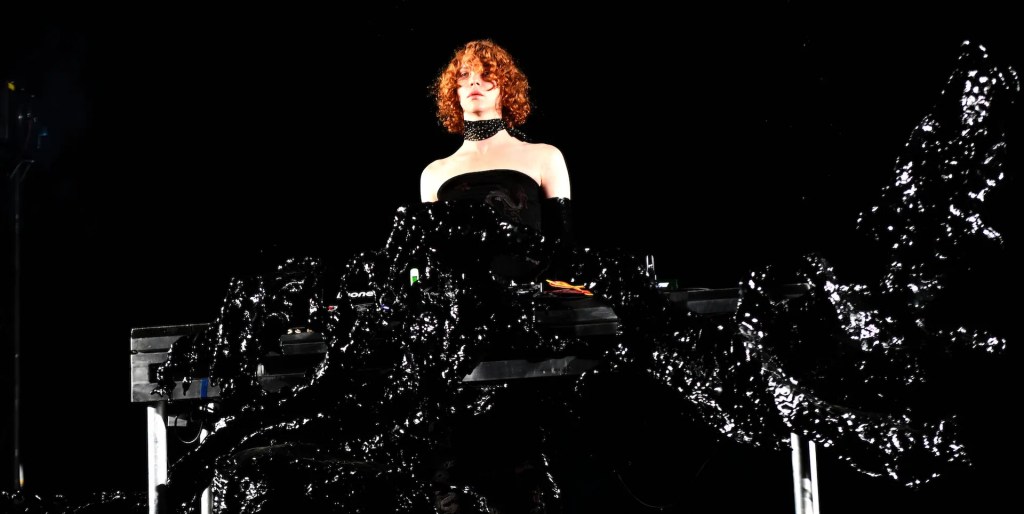

Always crouched behind the concept of femininity, a behemoth of a term in its own right, is the concept of youthfulness: girlhood in a Sofia Coppola-sized frame adorned with ringlets of curly hair, lashes that get longer and longer, Bridgette Bardot-type bows. Putting femininity into words results in a diverse, inclusive array of answers. This verbal understanding of the term does not translate as seamlessly into women’s fashion, whose interpretation of femininity tends to skew towards a certain image (think of the most typical interpretation possible).
Though some large fashion brands, houses, and individuals seem to have an affinity towards a shared ideal of traditionally feminine dress, prominent outliers to this ideal contradict this vision, introducing varied elements that challenge fashion’s portrayal of femininity.
Creating a metaphorical scrapbook page using different examples from popular media and brands can provide some semblance of a definition for femininity in the context of style, taste, and fashion.
Looking to popular social media platforms such as Instagram, Pinterest, and TikTok define femininity through some interpretation of the “coquette” aesthetic, a modern-day reimagining of the youthful, childish experience of girlhood. Strictly girlhood.
Vanguards of this movement, such as singer-songwriter Gracie Abrams and large fashion brands such as Sandy Liang spearhead this movement towards this idolization of lolita beauty. This baby pink with lace frills style, although beautiful due to its calming colors, nostalgic air, and dreamy vibe, can also be dangerous. It traps femininity in a box that only allows it to exist within the constraint of youth, shining a negative light on aging.
Although it is a natural function of life, aging has long been feared by feminine figures, as the increase of age is commonly associated with the decrease of beauty. This fear is not just historical, as social media falls into an endless spiral of anti-aging techniques inside a reverberating box, the desperation to avoid getting older blanketing most aspects of the online beauty and fashion spheres. “How to get rid of smile lines,” “gua shuas,” and “preventative botox” are among common searches on TikTok as the fear of passing time is instilled in girls far too young to be worrying about something as inconsequential as wrinkles.
Film has, many times, been used as a mode to warn against this obsession with girlhood. In Darren Arronofsky’s Black Swan, he uses the main character’s (Nina) mother as a personification of this box of youthfulness. As a result of her circumstances, Nina is preyed upon in different ways by her mentor and her peers. Black Swan serves as a parallel to real-life situations, showing how girls who are conditioned into submissiveness can be negatively affected in their adult lives. Though the girlhood-reminiscent style does not always propagate submissive ideals, many people who promote these trends convey undertones that are eerily similar.
Girlhood, however, does not always have to be equated with notions that could prove harmful to the feminine experience. Conversely to this promotion of “traditional girlhood,” brands like Bode and Schiaparelli embrace notions of womanhood, with an emphasis on maturity instead of childishness. Bode, a female-led menswear brand, recently introduced a womenswear line in 2023. Instead of making this womenswear line centered around the typical ideal of feminine fashion, Bode unveiled a baseline for a much more casual look — think flapper-esque dresses, trousers, and button up shirts. Many of these silhouettes mirrored those of the menswear line, as Bode blurred the boundaries between genders and seemed to redefine femininity with a distinctive informality that does not bind up women’s styling in accordance with the conventions for womenswear.
Similar to Bode’s love for loose silhouettes, many aspects of women’s street style also call to a more ambiguous form of dress, while still accounting for aspects of “typical” femininity through accessories such as hair bows, well-manicured nails, and rings/necklaces. “Blokette,” which has only increased in popularity since the 2022 Fifa World Cup, serves as a good example of this blend of masculine and feminine traits. In this style, the silhouette of an outfit is generally reminiscent of men’s street style, with baggy jerseys and bottoms, while accessories differentiate its wearer, upping the femininity of the outfit.
Schiaparelli obliterates the seemingly indestructible links between femininity and youthfulness in a different way, however. Instead of adding elements that make the wearer look innocent, Schiaparelli seems to equate femininity with a kind of ferocity, directly contradicting the message popularized by promoters of hyperfemininity. This is especially evident in their S/S 2023 Haute Couture line, where many ensembles are large, showy, and in-your-face, reminiscent of the primal instinct wild animals call upon when they want to appear threatening, with some designs even displaying animal heads.
This is not to say that typical femininity should be completely shied away from, as there is beauty in all forms of feminine expression. Rather, the path of divulging in this classic style should be tread with awareness of the possible dangers that lie ahead. Ultimately, femininity always has and always will be fluid, ebbing and flowing between traditional understanding of feminine and masculine, finally settling somewhere comfortable for the wearer. Femininity is defined by its dynamic nature, and can be conveyed through loud, intricate outfits or whispers of subtle accessories.
Reach writer Preethika Makineni at musemediauw@gmail.com.
Instagram @pr3eth1